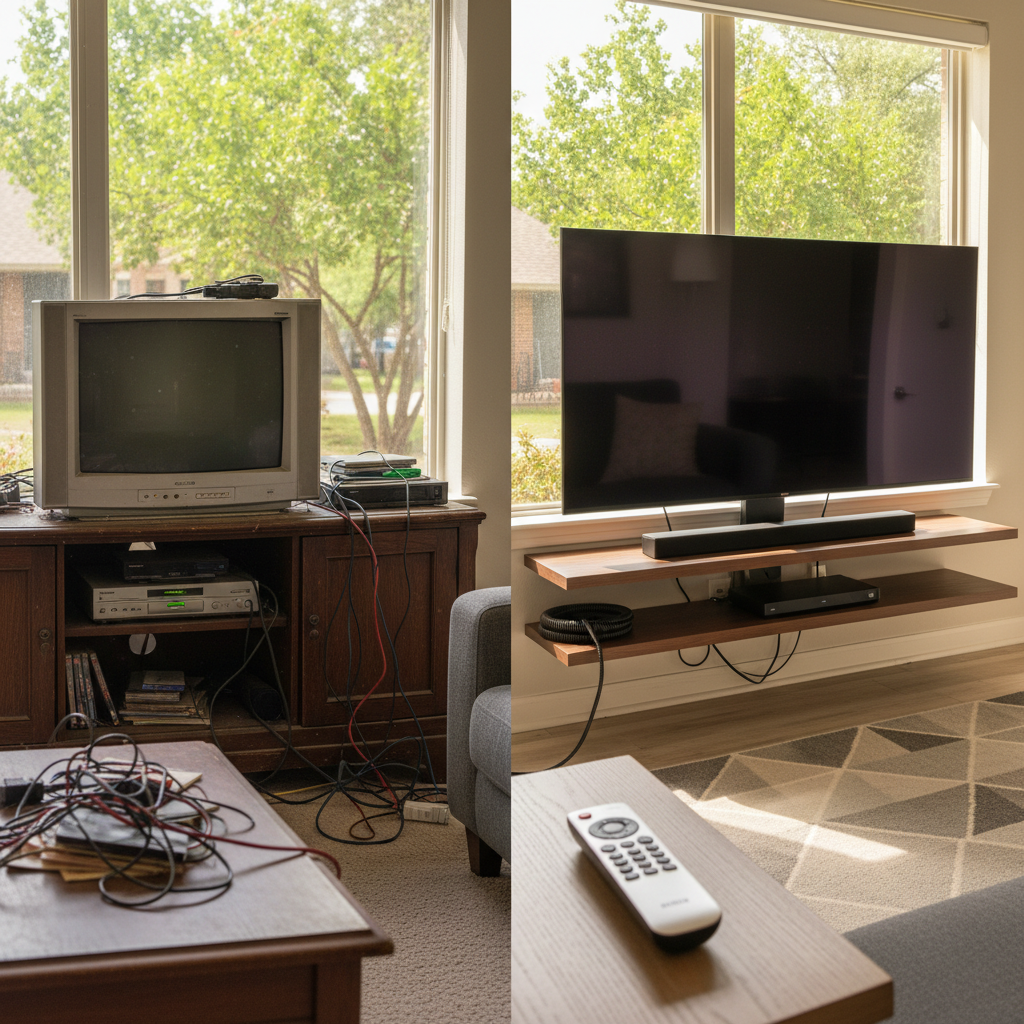
You've finally got that sweet home theater set up, or maybe you're just sick of having five different remotes scattered across the coffee table. The next logical step is a universal remote, right? But then you hit a snag: do you try to program that thing yourself, or do you call someone like us to do it for you? It's a common question I get from folks all over San Antonio, from Alamo Heights to the new builds out in Stone Oak.
The DIY Approach: Saving a Buck, Spending Your Time
Let's be honest, the main reason most people consider programming a universal remote themselves is to save a few bucks. And hey, I get it. We all want to be smart with our money. You buy the remote, you watch a few YouTube videos, you dig out the manuals for your TV, soundbar, Blu-ray player, and whatever else you've got hooked up. Then you start punching in codes or going through the learning process.
- Cost: Your only upfront cost is the remote itself, which can range from fifty bucks for a basic one to a few hundred for something more advanced.
- Durability: The remote's durability is the same no matter who programs it.
- Maintenance: If something stops working, you're on the hook to figure out why and reprogram it. That could be a firmware update on your TV, a new device, or just a glitch.
- Appearance: You get to pick the remote you like.
- Time Investment: This is where it gets tricky. For a simple setup (TV, soundbar), it might take you an hour or two. But if you've got an AV receiver, a media streamer, a game console, and maybe some smart lighting integrated, you could be spending an entire Saturday. And if you run into compatibility issues, you might just throw the remote across the room.
- Performance: Often, DIY setups get the basic functions working, but you miss out on the advanced stuff – custom macros, activity-based controls (like 'Watch Movie' that turns on the TV, receiver, and Blu-ray, and sets the right inputs). You might still find yourself grabbing another remote for specific functions.
I've seen plenty of homeowners get halfway through programming, get frustrated, and then just live with a half-baked solution. Or they call us up saying,